Corrosion and Sacrificial Anodes
Understand the principles of electrochemical corrosion and the importance of sacrificial anodes in protecting vessels.
What Is Galvanic Corrosion
Every vessel, whether docked or navigating in fresh, salt, or brackish water, is subject to corrosion.
Its effects can cause serious damage and generate high maintenance costs for vessel owners.
When metals are immersed in an electrolyte, such as seawater, they exhibit different electrochemical potentials.
When in contact, they form a galvanic cell, where the metal with the lowest potential (less noble) is corroded, while the metal with the highest potential (more noble) is protected.
A practical example is the set formed by a bronze propeller and a stainless-steel shaft.
Submerged in seawater, bronze (less noble) tends to corrode, while stainless steel (more noble) is protected.
⚙️ Bronze propeller and stainless-steel shaft — bronze tends to corrode while stainless steel is protected.
Sacrificial Anodes and the Galvanic Series
To protect different metals in contact with seawater, it is necessary to add a third metal that is even less noble, such as zinc.
This metal acts as a sacrificial anode, corroding in place of the other metals and ensuring their integrity and longer life.
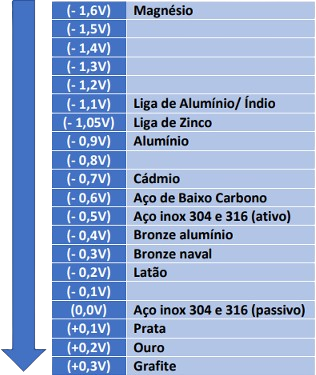
The galvanic series is used in practice — a ranking of metals according to their electrochemical behavior in seawater.
Metals with lower electrical potential (less noble) corrode first, protecting those with higher potential (more noble).
Below are the main metals used and their average potentials:
Magnesium: –1.60 V
Aluminum/Indium Alloy: –1.10 V
Zinc: –1.05 V
💡 The greater the potential difference between the anode and the metal being protected, the more efficient the cathodic protection.
Practical Application Examples:
Protection of a bronze propeller with zinc:
–1,05 V – (–0,30 V) = –0,75 VProtection of a bronze propeller with aluminum/indium alloy:
–1,10 V – (–0,30 V) = –0,80 V
✅ Conclusion: Aluminum/indium alloy offers greater protection than zinc, making it more efficient in marine environments.
Current Capacity and Durability
The second essential factor when choosing an anode is its current capacity and durability.
The anode operates by generating a voltage difference, conducting current through the water to the metal being protected.
The higher the current capacity and the greater the mass (size) of the anode, the longer its service life.
A magnesium anode lasts about 30% as long as zinc, while an aluminum anode lasts up to 50% longer than zinc.
| Material | Capacidade (dias) |
|---|---|
| Magnésio | 30 |
| Zinco | 100 |
| Alumínio | 130–150 |
Alloy Quality
The third essential factor when choosing an anode is the quality of the metal alloy used.
Not all zinc, aluminum, or magnesium available on the market is suitable for anode production — impurities or improper alloying compromise performance and vessel safety.
ZIGMO ensures that all anodes are produced according to national and international standards, guaranteeing correct composition and high performance:
Zinc: ABNT NBR 9358 (Brazil) / MIL-A-18001K (USA)
Aluminum: ABNT NBR 10387 (Brazil) / MIL-A-24779(SH) (USA)
Magnesium: ABNT NBR 16460 (Brazil) / MIL-A-21412(SH) (USA)
Choosing the Right Anode for Each Environment
Each aquatic environment requires a specific anode to guarantee optimal protection.
Fresh water
Magnesium — the most active and effective
Brackish water
Aluminum — best performance, remains active without forming crusts
Salt water
Zinc or Aluminum — both suitable; aluminum lasts longer and is more efficient
⚠️Attention: Magnesium anodes must not be used in salt water — they wear out too quickly and leave the vessel unprotected.
🛡️ Aluminum is the most versatile anode: works well in all water types, lasts longer than zinc, and is lighter and environmentally friendly (0% cadmium).